
GDM runs on 64-bit Windows 10 and Windows 11, and on 64-bit Linux: see On Linux. Builds for macOS are new and still experimental: see On a Mac.
Escolher uma transferência
Todas as versões estão na página Lançamentos. Para Windows, existem três ficheiros:
| Ficheiro | O que é |
|---|---|
MisterDownloadManager-<version>-setup.exe |
The installer. Pick this one unless you have a reason not to. It can set up browser integration and open .torrent files and magnet links with GDM. |
MisterDownloadManager-<version>-portable.zip |
Uma cópia portátil. A lista de transferências e as definições permanecem numa pasta data ao lado do programa, e nada é escrito no registo. A integração com o navegador requer o instalador. Consulte Modo portátil. |
MisterDownloadManager-<version>-x64.zip |
Os mesmos programas sem instalador. Mantém os seus dados em %APPDATA%\misterdownloadmanager, como uma cópia instalada. |
Em Linux
GDM runs on 64-bit Linux with a desktop session. It is tested on Ubuntu 24.04, Debian 12 and
Fedora, with GNOME, KDE Plasma, Xfce and Cinnamon, on X11 and in Wayland sessions. Pick one
of these files (up to version 0.2.4, their names end in -experimental, as in
...-linux-x86_64-experimental.deb):
| Ficheiro | O que é |
|---|---|
...-linux-x86_64.deb |
For Ubuntu, Debian, Mint and Pop!_OS: sudo apt install ./<file>.deb. It brings the libraries GDM needs. |
...-linux-x86_64.rpm |
For Fedora, openSUSE and RHEL: sudo dnf install ./<file>.rpm. It brings the libraries GDM needs. |
...-linux-x86_64.AppImage |
Funciona na maioria das distribuições: torne-o executável (chmod +x) e execute-o. Atualiza-se no local (Ajuda → Procurar atualizações). |
...-linux-x86_64.tar.gz |
Os programas simples, para qualquer distribuição. |
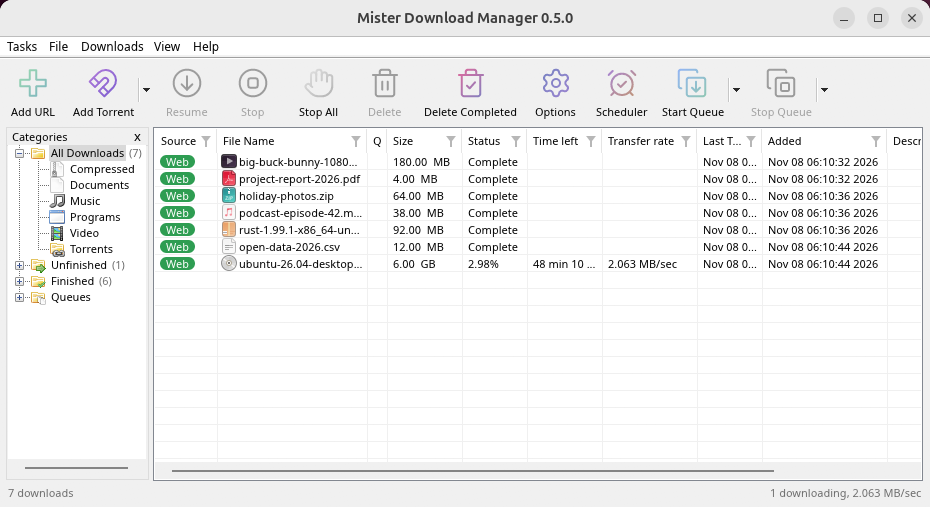
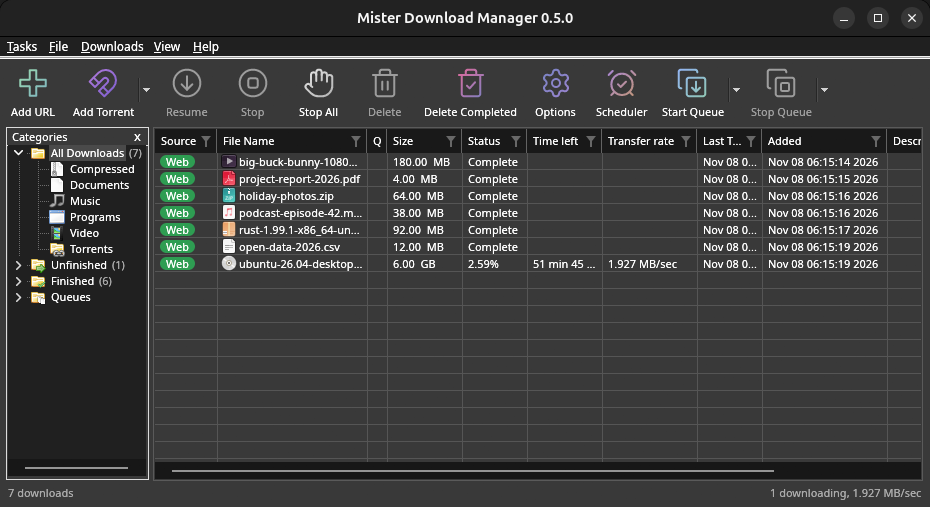
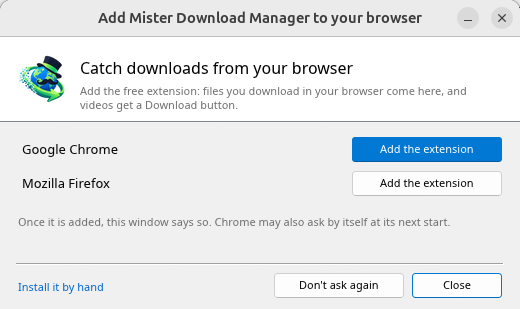
Browser integration is set up by GDM itself at each start (the browsers installed then are found); add the extension as in Browser integration. Firefox installed as a Snap (Ubuntu's) reaches GDM once you allow it; other Snap and Flatpak browsers can't (see Flatpak and Snap browsers). The tray icon, Dark Mode support and Launch on startup work on GNOME (Ubuntu's), KDE Plasma, Xfce and Cinnamon.
In a Wayland session the windows go through XWayland (below). Not there yet on Linux: screen readers (Orca) don't read GDM's windows; browsers installed as a Flatpak can't reach GDM (Firefox from Flathub may, through the desktop as the Snap does, but that isn't checked yet); and View → Draw with → Vulkan is a choice, OpenGL stays the default.
In a Wayland session (GNOME, KDE Plasma and others), GDM's windows run through XWayland when it is there: Wayland doesn't let a program place its own windows, so GDM's menus and drop-down lists would open in the middle of the screen. To run on Wayland itself anyway, start it with MDM_WAYLAND=1 misterdownloadmanager. If the system lacks a library X11 windows need (such as libxkbcommon-x11, which the .deb and .rpm bring but the AppImage and the tar.gz can't), GDM opens on Wayland instead; with no window system it can use, it names what's missing and the command that installs it.
As janelas são as descritas nesta ajuda, com os tipos de letra, ícones de ficheiro e barras de título do ambiente de trabalho:
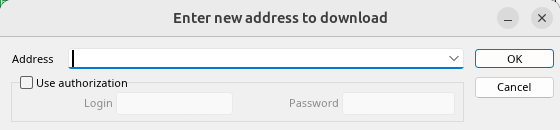
Adicionar URL. 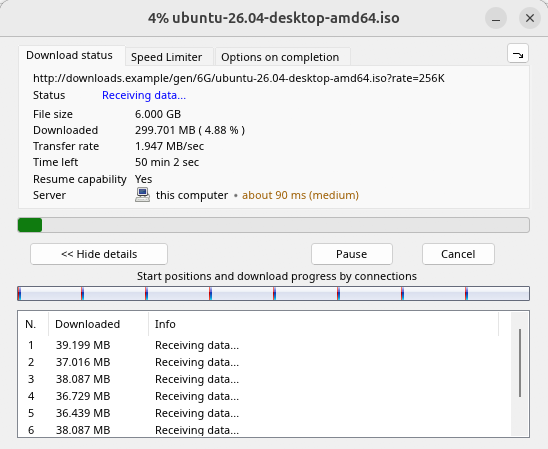
Progresso de uma transferência. 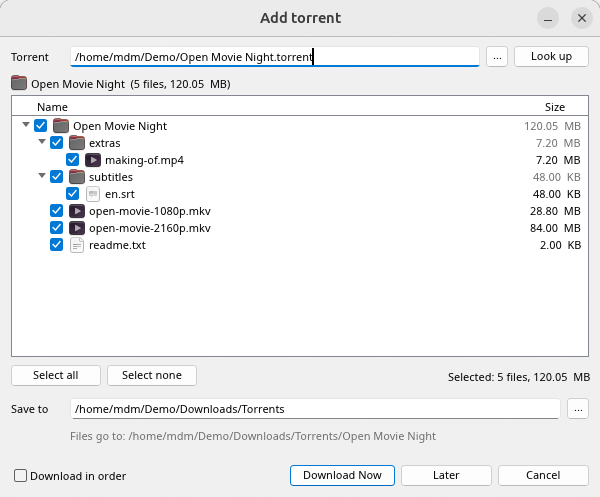
Adicionar torrent. 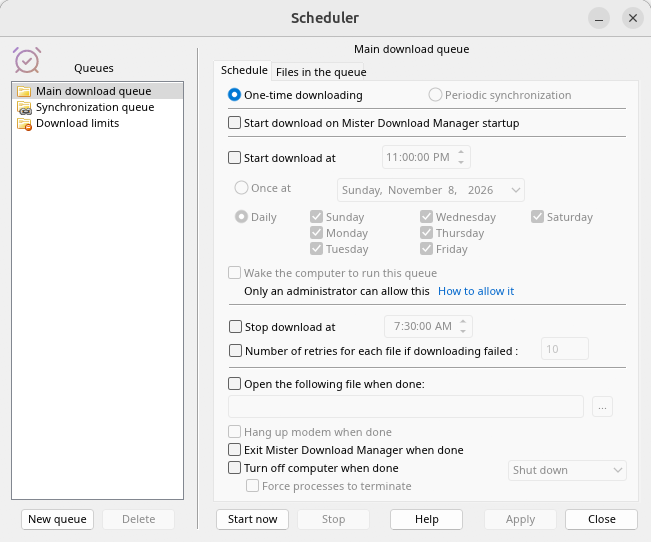
O Agendador. 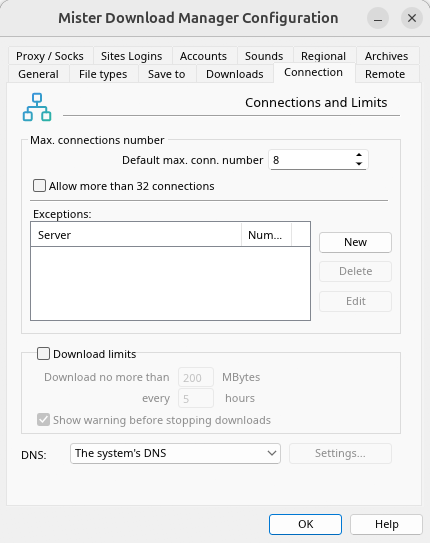
Opções.
E nos outros ambientes de trabalho em que foi verificado:
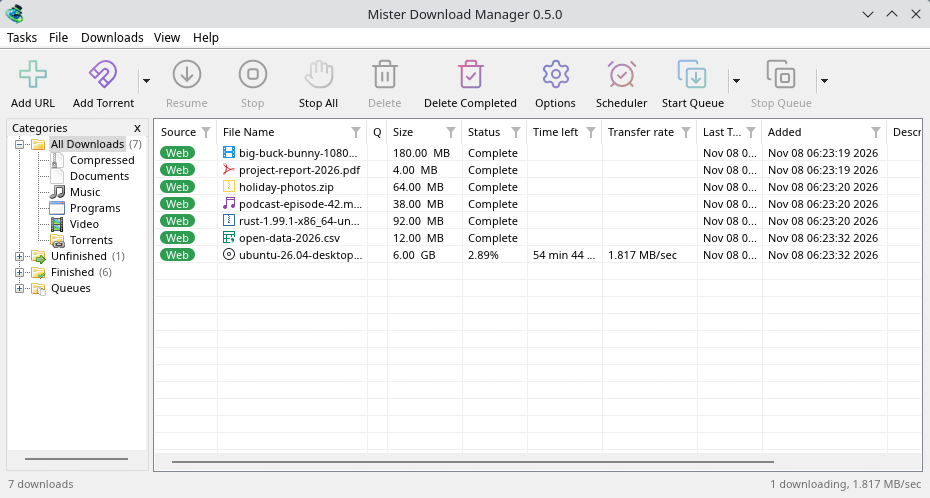
KDE Plasma. 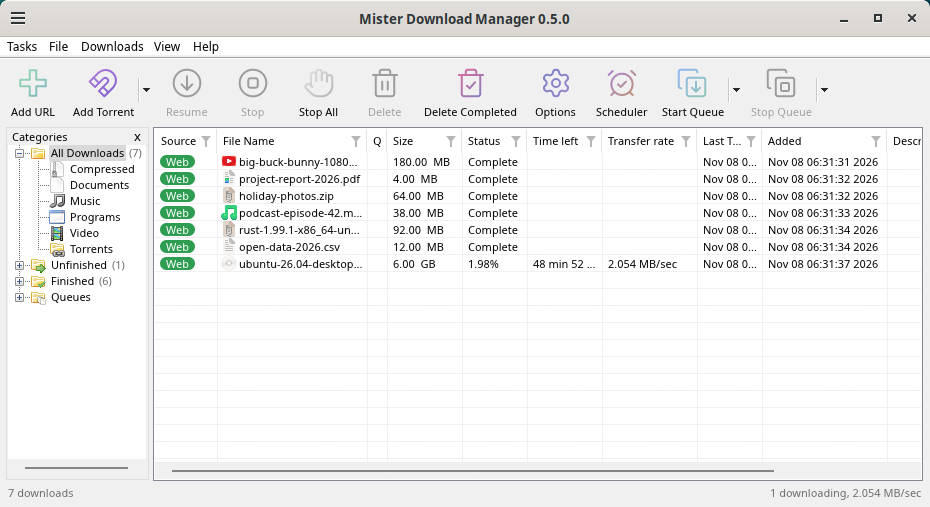
Cinnamon. 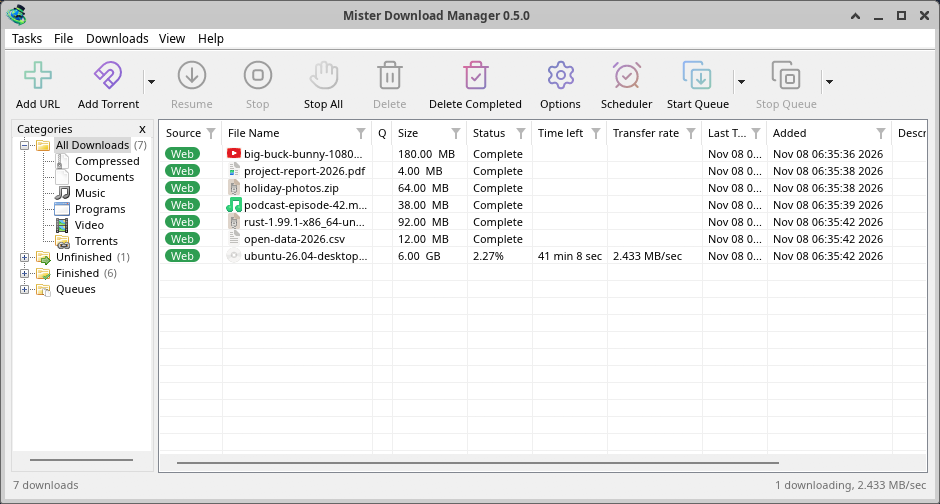
Xfce.
Desinstalar em Linux
sudo apt remove misterdownloadmanager (or sudo dnf remove misterdownloadmanager) removes the
programs, and the small files that tell your browsers where GDM's helper is: the .deb and .rpm
install those for everyone (in /etc and /usr/lib), for Chrome, Chromium, Edge, Brave, Vivaldi
and Firefox (the Snap too), so GDM doesn't write them in your home folder. For the AppImage or the
tar.gz, delete the file or the folder.
What GDM keeps in your home folder stays, as with any package: your list and settings
(~/.local/share/misterdownloadmanager), the AppImage's and the tar.gz's browser files, and
those of the browsers that read them only there (Opera, Helium, Thorium, and Firefox's forks:
Zen, LibreWolf, Floorp, Waterfox). A package can't remove those: it never touches
home folders. Without GDM they lead nowhere, so the extension says it can't reach GDM. To remove
them as well, run this as each user who used GDM, before uninstalling:
misterdownloadmanager-nmhost --unregister
(Do AppImage: ~/.local/share/misterdownloadmanager/browser-host/misterdownloadmanager-nmhost --unregister.) Já desinstalou? Isto remove os mesmos ficheiros:
find ~/.mozilla ~/.librewolf ~/.config -name com.misterdownloadmanager.host.json -delete 2>/dev/null
Num Mac
As versões para macOS são recentes e ainda experimentais: ainda não as experimentámos num Mac, por isso seria dos primeiros. Por favor, diga-nos como correu, bem ou mal.
| Ficheiro | O que é |
|---|---|
...-macos-arm64-experimental.dmg |
For a Mac with Apple Silicon (M1 or later: Apple menu → About This Mac shows a Chip). Open it and drag GolinksPRO Download Manager to Applications. macOS asks before its first start, because the app isn't notarized by Apple: right-click it and choose Open (on macOS 15 and later: System Settings → Privacy & Security → Open Anyway). |
...-macos-x86_64-experimental.dmg |
O mesmo, para um Mac com processador Intel (Acerca deste Mac mostra um Processador). |
Browser integration is set up by GDM itself at each start (the browsers installed then are found); add the extension as in Browser integration.
Instalar com a configuração
- Execute
MisterDownloadManager-<version>-setup.exe. - Choose the language. Windows' display language is already selected. The setup offers every language GDM has, and GDM starts in the one you pick.
- Escolha se pretende instalar apenas para si ou para todos no computador. A opção apenas para si não requer direitos de administrador e vai para
%LOCALAPPDATA%\Programs\GolinksPRO Download Manager. A opção para todos vai paraProgram Files. - Pick what the setup should do: - Set up browser integration (Chrome, Edge, Brave, Firefox) - Open .torrent files and magnet links with GolinksPRO Download Manager - Start GolinksPRO Download Manager when Windows starts - Create a desktop shortcut (off unless you tick it)
- Click Install, then Finish to start GDM.
If GDM is already running, the setup asks it to save and close first. To update, use Help → Check for updates → Update now, or run the setup of the new version; your list and settings stay.
A integração com o navegador precisa de mais um passo em cada navegador: adicionar a extensão. No Firefox, clique em Adicionar ao Firefox na sua página em addons.mozilla.org; no Chrome, Edge, Brave, Opera e Vivaldi, clique em Adicionar ao Chrome na sua página na Chrome Web Store. A integração com o navegador mostra como.
Desinstalar
Uninstall GDM from Windows Settings → Apps. The uninstaller asks whether to delete your download list and settings too. Your downloaded files are never touched.
Usar uma cópia zip
- Extraia o ficheiro para uma pasta onde tenha permissões de escrita (não diretamente em
Program Files). - Execute
misterdownloadmanager.exe.
Os ficheiros ZIP contêm os mesmos programas que o instalador: a aplicação, misterdownloadmanager-cli.exe (para transferir a partir da linha de comandos; consulte Linha de comandos e automação) e a pasta extension.
Primeiro arranque e idioma
- Installed with the setup: GDM starts in the language you chose in the setup.
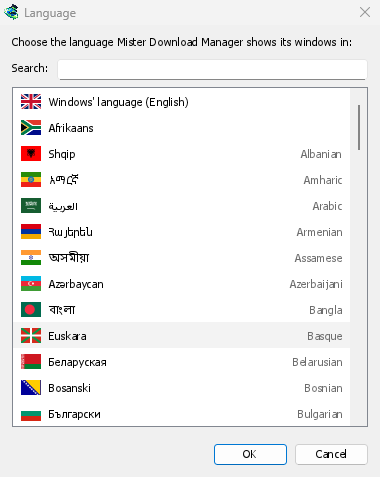
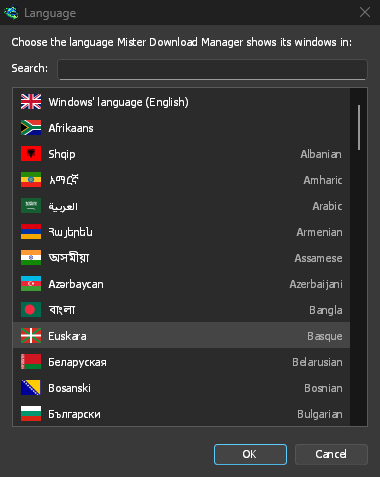
- Otherwise: GDM shows the list of languages, each with its flag and its own name. Pick yours.
Pode alterá-lo a qualquer momento em Ver → Idioma. Mais informações em Idiomas.
As ferramentas de vídeo
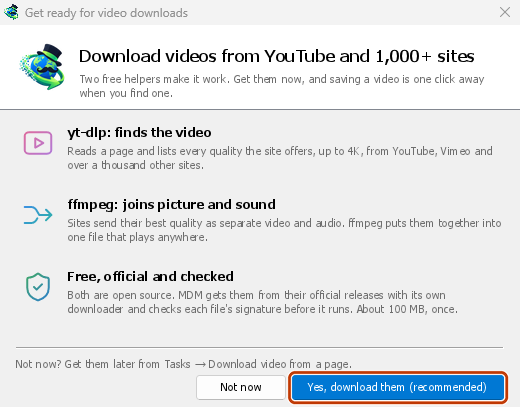
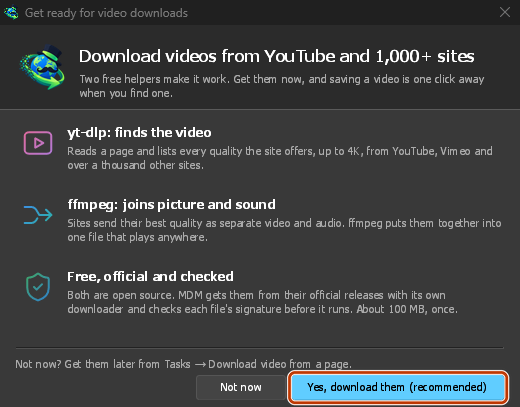
Next, GDM offers its two free video helpers: yt-dlp, which finds the video on a page, and ffmpeg, which joins its picture and sound. Click Yes, download them (recommended) and they download in the background, about 100 MB, once. Not now leaves them for later: the video window offers them when you first need them. More in Videos.
A janela principal
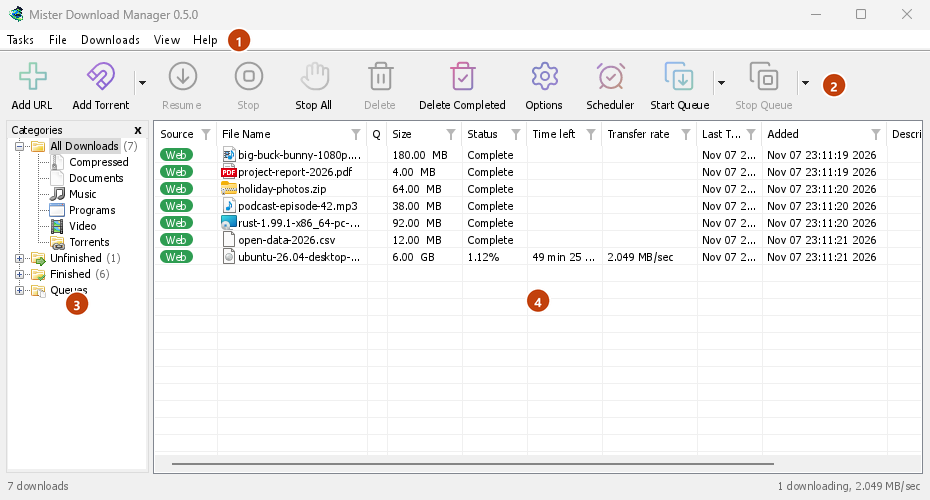
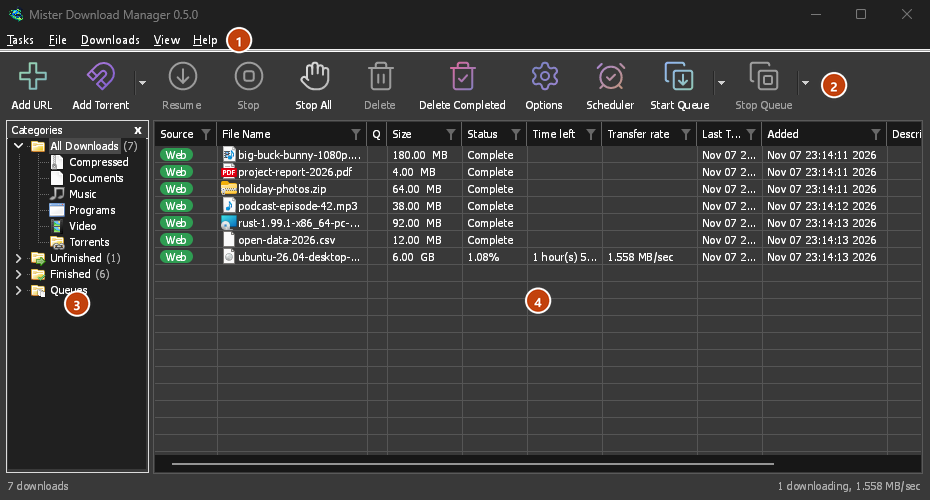
De cima para baixo:
- Barra de menus.
- Tarefas — adicionar transferências, torrents, ligações magnéticas, transferências em lote e vídeos de uma página; Definições de torrent; Link grabber; Feeds RSS; mostrar o destino de arrastar e largar; importar e exportar a lista; sair.
- Ficheiro — a transferência selecionada: Parar Download, Remover, Transferir Agora, Transferir novamente.
- Transferências — Pausar Tudo, Parar Tudo, Eliminar Todos os Concluídos, Procurar, o Agendador, filas, o Limitador de Velocidade e Opções.
- Ver — mostrar ou ocultar as categorias, ordenar a lista (Organizar ficheiros), Suporte para Modo Escuro, Sempre escuro, Tema, Tamanho da interface (todas as janelas maiores, 100 % a 200 %; Ctrl +, Ctrl − e Ctrl 0 também), Desenhar com (OpenGL, ou Direct3D no Windows, Vulkan no Linux, Metal no macOS) e Idioma.
- Help — help pages and tutorials (on the website, in your language when it has it), Keyboard shortcuts, Report a problem, Check for updates, About, Tell a friend and Support GDM (its creator's GitHub Sponsors page: optional, nothing in GDM changes).
- Barra de Ferramentas. Adicionar URL, Adicionar Torrent, Retomar, Parar, Parar Tudo, Eliminar, Eliminar Concluídas, Opções, Agendador, Iniciar Fila, Parar Fila. A pequena seta ao lado de Adicionar Torrent, Iniciar Fila e Parar Fila abre mais opções.
- Categorias (à esquerda). Escolha o que a lista apresenta: Todos os Downloads, Inacabado, Concluídos e Filas, cada um com as respetivas categorias. Arraste o espaço entre o painel e a lista para alargar o painel.
- Lista de transferências (à direita). Uma linha por transferência. Consulte A lista de transferências.
Modo escuro
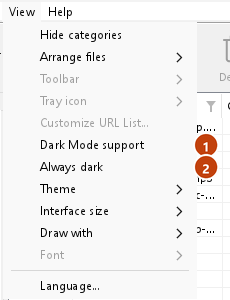
GDM follows your system: when Windows (or your desktop's light/dark preference on Linux and macOS) is set to dark mode, so is GDM. To keep GDM light whatever the system does, turn off View → Dark Mode support. To keep it dark whatever the system does, for example on a desktop that reports no preference, turn on View → Always dark.

Temas
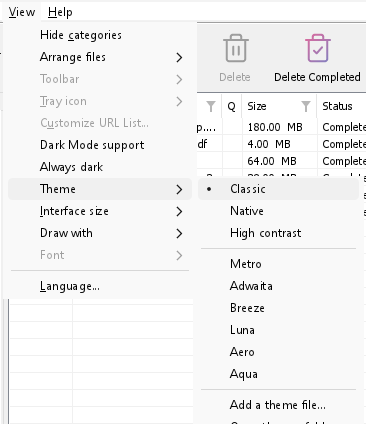
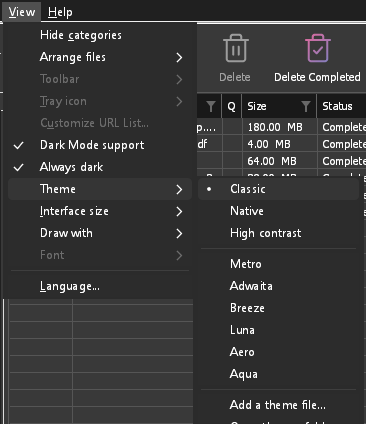
View → Theme changes GDM's look at once, keeping its layout:
- Classic: GDM's own look, the default.
- Nativo: as cores do sistema. A cor de destaque do Windows (Definições → Personalização → Cores) e, quando ativado, o tema de alto contraste; a cor de destaque do ambiente de trabalho e a opção de alto contraste no Linux (GNOME 47 e posteriores, KDE Plasma); a cor de destaque no macOS. O tema acompanha as alterações que fizer.
- Alto contraste: preto e branco, uma cor de destaque viva, todos os contornos desenhados e texto com um contraste de 7:1 ou superior.
- Metro: Windows 8's flat look: square corners, flat buttons and boxes, a coloured title bar with the title centred (on Windows, where GDM draws it), and one-colour icons (Microsoft's Fluent UI System Icons).
- Adwaita: GNOME's look: round corners, flat grey buttons, a rounded focus ring, GNOME's check boxes, a header bar with the title in bold and round buttons (on Windows, where GDM draws it), and GNOME's Adwaita icons, in colour for files and categories, one colour in the toolbar.
- Breeze: KDE Plasma's look: rounded corners, buttons and boxes that take the accent's edge under the pointer or when focused, KDE's check boxes and focus frame, KDE's title bar with the title centred and round buttons (on Windows, where GDM draws it), and KDE's Breeze icons.
- Luna: Windows XP's look: buttons shaded from white with an orange glow under the pointer, green ticks, square text boxes, progress in green blocks, a deep blue title bar with the title in bold (on Windows, where GDM draws it), and colourful icons drawn for GDM in that manner.
- Aero: Windows 7's look: glossy buttons that turn light blue under the pointer, quiet check boxes, a glossy green progress bar, a glassy title bar with the title on a soft glow (on Windows), and glossy icons drawn for GDM in that manner.
- Aqua: Mac OS X's look: gel buttons round at the ends (the default one blue), glossy check boxes, a blue focus ring, a blue gel progress bar, a grey title bar with small round buttons (on Windows), and icons drawn for GDM in that manner.
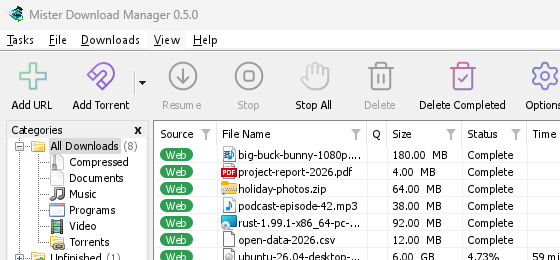

Clássico 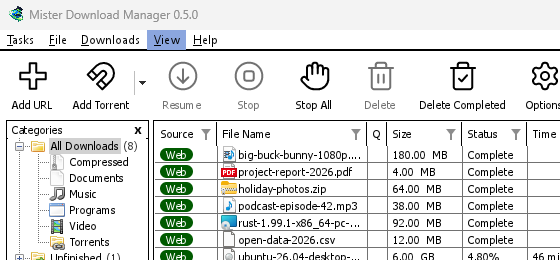
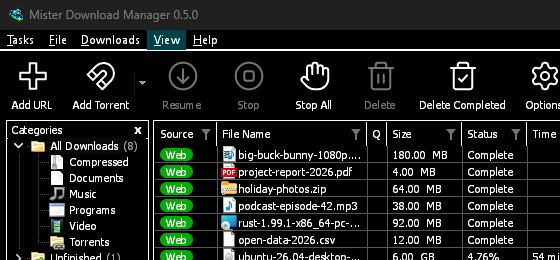
Alto contraste 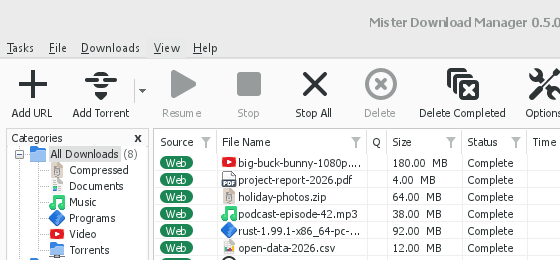
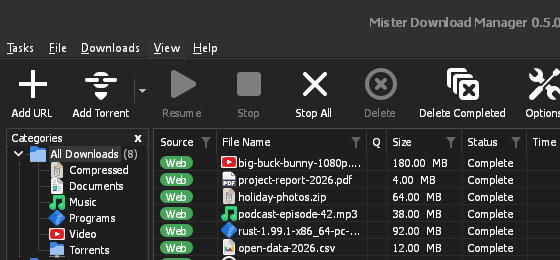
Adwaita 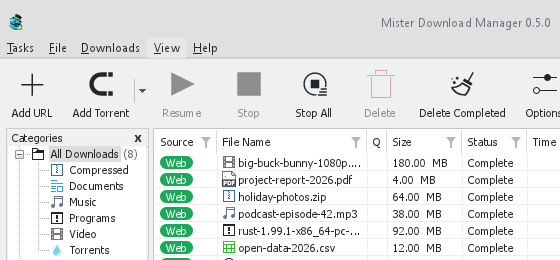
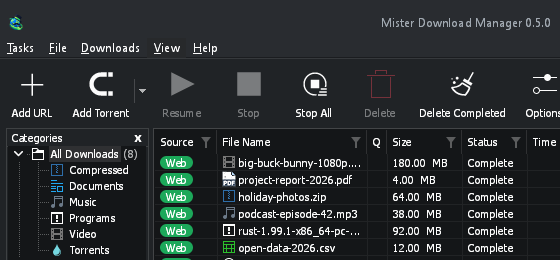
Breeze
Cada um tem um lado claro e um lado escuro: Suporte para Modo Escuro e Sempre escuro escolhem entre eles como antes. Os ficheiros de tema que colocar na pasta de temas (Ver → Tema → Abrir pasta de temas) também são listados lá, assim como os esquemas de cores Base16 e pywal (Ver → Tema → Adicionar um ficheiro de tema…; pywal segue wal enquanto é executado): Temas indica onde está essa pasta, o que um ficheiro de tema contém (inherits, cores, tamanhos, formas de controlo, ícones), como as cores de um esquema são usadas e como criar e partilhar um.
O ícone da bandeja
Closing the main window doesn't quit GDM. It hides in the notification area, and downloads, queues and schedules carry on. To make closing quit (a portable copy's folder can then be deleted), untick Options → General → Keep running when closing the window. If there is no icon for GDM at all — not in the notification area, nor behind the ^ hidden icons — the window minimizes to the taskbar instead, so downloads continue and there is a way back. An icon behind ^ can be clicked to bring the window back, and starting GDM again always does.
On Linux this needs a tray, which most desktops have (KDE Plasma, Xfce, Cinnamon, Ubuntu's GNOME or GNOME with the AppIndicator extension, waybar's tray). On a desktop without one (some tiling window managers), closing the window quits GDM, since there would be nowhere to bring it back from.
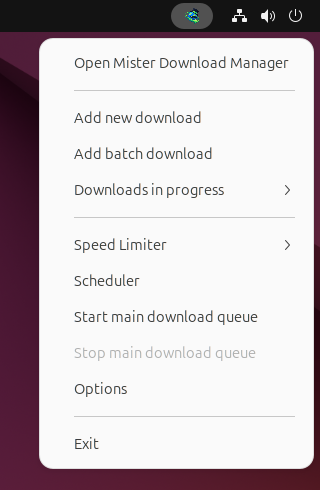
- Clique no ícone da bandeja para trazer a janela de volta.
- Clique com o botão direito do rato para Adicionar novo download, Adicionar download em lote, Transferências em curso, Limitador de Velocidade, Agendador, a fila de downloads principal, Opções e Sair.
- Transferências em curso lista os downloads em execução. Escolha um para ver a sua janela de progresso.
Minimizar também oculta a janela principal lá, enquanto Minimizar para a área de notificação estiver ativada em Opções → Geral. Está ativada por predefinição; onde a área de notificação não tem ícone, Minimizar envia a janela para a barra de tarefas.
A janela de progresso de uma transferência também pode ir para lá, com o seu botão Minimizar ou com o seu botão Ocultar para a área de notificação: um pequeno traço com uma seta para baixo no canto.
No Windows, esse botão está na barra de título da janela, à esquerda de Minimizar, e no menu da barra de título (Alt+Espaço). No Linux e macOS, está no final da linha de separadores.
Para trazer a janela de volta, escolha-a em Transferências em curso, ou faça duplo clique na transferência na lista.
Para sair, escolha Tarefas → Sair ou Sair no menu da bandeja.
Where GDM keeps its data
A lista de transferências e as definições estão em %APPDATA%\misterdownloadmanager (downloads.json); no Linux em ~/.local/share/misterdownloadmanager, num Mac em ~/Library/Application Support/misterdownloadmanager. Uma cópia portátil mantém-nas na sua pasta data. Os ficheiros transferidos vão para a sua pasta Transferências, organizados numa pasta por categoria; pode alterar isso em Opções → Guardar em.
Próximos passos
Gratuito, de código aberto, sem anúncios, sem período de avaliação.
Download GolinksPRO Download Manager